
NZLA Constitution
The New Zealand Literacy Association Incorporated (NZLA), including the Definitions section and fully aligned with the Incorporated Societies Act 2022 and the Charities Act 2005.
The Constitution of
THE NEW ZEALAND LITERACY ASSOCIATION INCORPORATED
He kete korero | Nau te rourou | Naku te rourou | Ka ora ai tatou
With your basket of knowledge and my basket of knowledge all will benefit
ARTICLE I – Definitions
In this Constitution, unless the context requires otherwise:
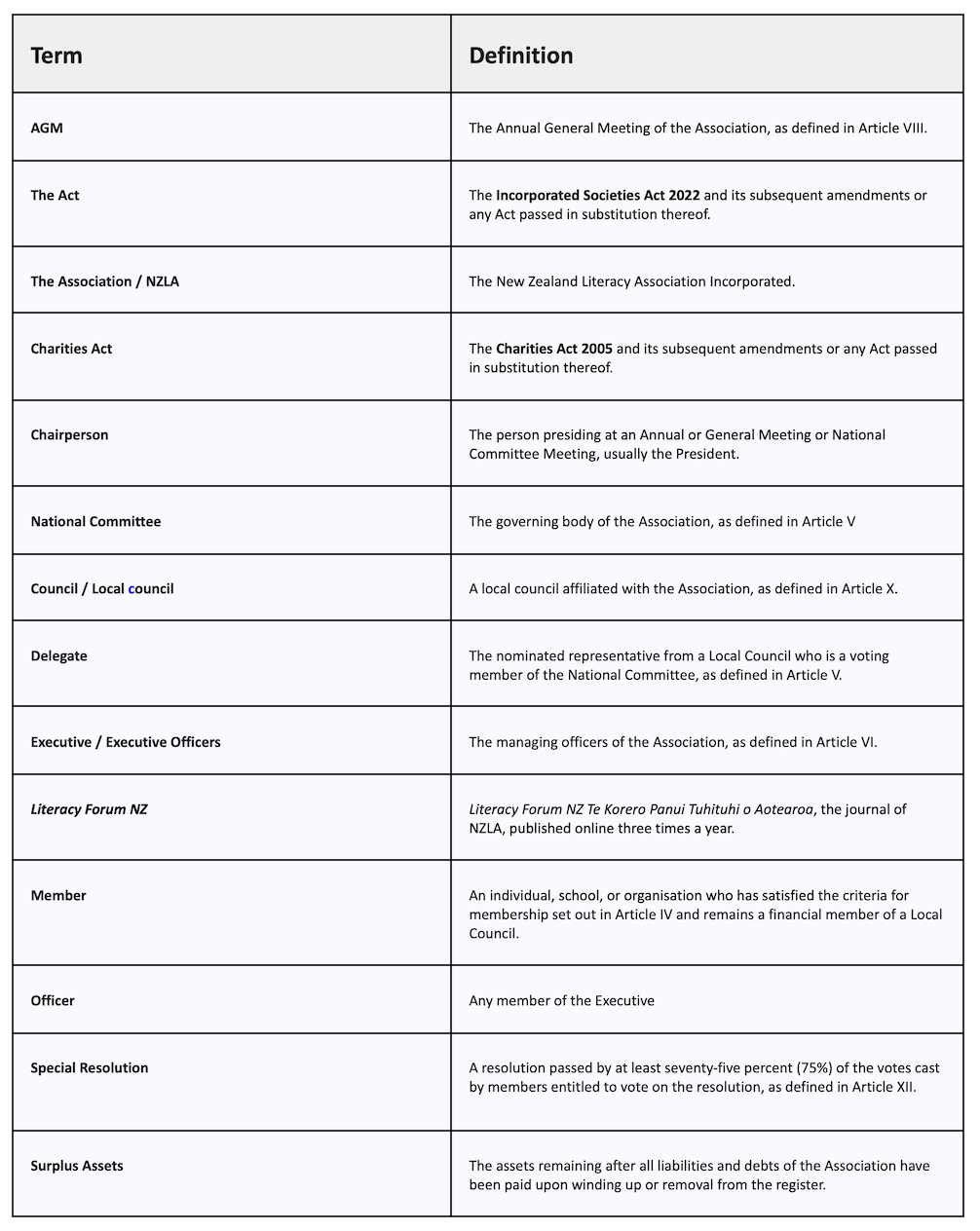
ARTICLE II – Name and Legal Status
2.1 Name: The name of the Society is The New Zealand Literacy Association Incorporated (referred to in this document as “the Association” or “NZLA”).
2.2 Legal Status: The Association is a body corporate incorporated under the Incorporated Societies Act 2022.
2.3 Charitable status: The Association was established for and is maintained exclusively for charitable purposes and not for the financial gain of any member. Any surplus will be applied to the charitable purposes of the Association.
ARTICLE III – Purposes and Charitable Nature
3.1 Vision: Growth Through Literacy.
3.2 Purposes (Objects):
The purposes of the Association are the advancement of literacy and literacy education and other charitable purposes within New Zealand and partnering with the International Literacy Association, including:
to encourage and actively promote enjoyment of literacy
to encourage literacy learning
to encourage research in literacy education
to publish results of significant literacy investigations and practices
to foster continuing literacy education programmes for teachers
to encourage and support the work of literacy councils in New Zealand
to provide and promote meetings and conferences on literacy
to foster national and international co-operation in the field of literacy
to advise and make representations on matters related to literacy.
These purposes shall be enacted through:
Research and Promotion of Literacy (Ngā Tautīnei)
Leadership (Hautūtanga)
Community (Hāpori)
Stewardship (Kaitiakitanga)
All such other things as are incidental or conducive to the attainment of the NZLA purposes.
3.3 Affiliation: The Association is affiliated with the International Literacy Association (or its successor). All Executive members shall also be financial members of the International Literacy Association, with their membership funded by the NZLA.
ARTICLE IV – Membership (ISA 2022, s 26(1)(c))
4.1 Eligibility: Membership shall be open to any individual or body corporate (e.g. school, or organisation) interested in the purpose of the Association. Membership is achieved through membership of a Local Council affiliated with the NZLA. Individual or body corporate members are members of both their Local Council and NZLA.
4.2 Becoming a Member: An individual, school, or organisation becomes a Member of the Association upon:
Joining a Local Council as an individual or as part of a group subscription or upon appointment by a local council as a life member.
Consenting to become a member of the Association (consistent with the Act).
Payment of the annual subscription to the Local Council. The membership year is from 1 January to 31 December.
4.3 Register of Members (ISA 2022, s 26(1)(c))
The Association shall maintain an up-to-date Register of Members that records, for each Member: a. full name b. contact details (email and/or postal address & telephone number) c. the Local Council they are affiliated with d. the date they became a Member e. the date they ceased to be a Member (if applicable).
Local Councils shall be responsible for supplying accurate membership information to the Association by: a. submitting a full annual membership return by 15 April each year, and b. notifying the Association of any changes (new Members, resignations, lapsed memberships).
The NZLA Secretary shall ensure that: a. the Register is kept securely b. updates from Local Councils are incorporated promptly c. the Register is available for inspection by Members only to the extent required by the Act d. information is handled in accordance with the Privacy Act 2020.
A Member is considered financial and current only while their name appears on the Register of Members.
Member records will be kept for 7 years once their membership is ceased.
4.4 National Levies: All financial members of Local Councils shall be deemed Members of the Association. Local Councils will pay a per capita levy to the National Treasurer at a rate determined by resolution at the AGM. The Executive may waive levies for a new council in its first year.
4.5 Ceasing Membership (ISA 2022, s 26(1)(c)): Membership of the Association is terminated by:
Voluntary Resignation: Giving written notice of resignation to the Local Council.
Failure to Pay: Falling into arrears with the Local Council subscription beyond a date notified by the Local Council. A Council with levies in arrears shall be notified by the Executive before further action is taken.
Resolution: Being removed by a resolution of the National Committee in accordance with the dispute resolution procedures (Article XI).
Death of the member.
ARTICLE V – National Committee (ISA 2022, s 26(1)(f))
5.1 Composition: The affairs of the Association shall be governed by the National Committee consisting of:
The Executive Officers (as defined in Article VI).
One Voting Delegate from each Local Council.
5.2 Authority, Roles, and Functions: The National Committee is responsible for governing the operations and affairs of the Association, including the power to:
Develop the Association's purposes, policies, and annual plan.
Oversee the Association’s finances, including raising loans, investing funds for the profit of the Association, or making loans to Local Councils.
Approve the annual budget.
Oversee the financial control and annual reporting.
ARTICLE VI – Executive Officers (ISA 2022, s 26(1)(g))
6.1 The role of the Executive: The affairs of the Association shall be managed by the Executive who shall meet or communicate formally, not less than three (3) occasions each year.
6.2 Executive Officers: The Executive shall consist of the following officers:
President
Secretary
Treasurer
President Elect or Past President
IT Co-ordinator (non-voting)
Literacy Forum NZ Editor (non-voting, other than at the Annual General Meeting)
Two other Representatives
6.3 Eligibility & Co-option:
Any Member of the Association is eligible for election to the Executive.
The President shall co-opt a Secretary and a Treasurer, who are members of a Local Council, for the duration of the President’s term of office.
For the duration of extraordinary assignments, the Executive may co-opt not more than two additional members, who have voting rights related to that assignment.
To qualify as an officer, the officer must:
be a natural person
consent in writing to be an officer; and
certify that they are not disqualified from being elected or appointed to office as per section 43 (3) of the Incorporated Societies Act 2022.
6.4 Term of Office:
The President, Secretary, and Treasurer shall serve a two (2) year term.
The term of the Treasurer may be extended beyond two years at the discretion of the incoming President.
The President Elect and Past President shall serve a one (1) year term.
All other executive officers shall serve a three (3) year term.
The terms of the Literacy Forum NZ Editor and IT Co-ordinator may be extended beyond three years at the discretion of the executive.
Elected officers shall commence their terms of office immediately after the closure of the annual meeting.
6.5 Officer Vacancies:
If the office of President becomes vacant, the Executive shall decide whether the President Elect or the Past President shall serve the unexpended portion of the term. If neither is available, the Executive shall select a President pro tem to serve the remaining portion of the term.
Any other Executive vacancy may be filled by appointment by the remaining Executive, with the appointee serving until the next AGM.
6.6 Officer Duties (ISA 2022, ss 54–61): Every Executive Officer must comply with the six mandatory duties of an Officer as set out in the Act:
Act in good faith and in the best interests of the Association.
Exercise powers for a proper purpose.
Comply with the Incorporated Societies Act 2022 and this Constitution.
Exercise reasonable care and diligence.
Not create a substantial risk of serious loss to the Association’s creditors.
Not incur an obligation the Officer does not reasonably believe the Association can perform.
6.7 Removal of an Officer:
In the event of an Executive Officer not complying with the six mandatory duties as set out in 6.6 or becoming disqualified from being an officer under section 47(3) of the Incorporated Societies Act 2022, the Officer may be removed from their position by a resolution passed at a Special General Meeting (SGM) of the Association.
Such a meeting may be called by the National Committee or by a written request from at least ten percent (10%) of the financial members.
The notice of the SGM must be sent to all members at least twenty-one (21) days in advance and must clearly state the motion for the Officer's removal and the reasons for it.
The Officer in question shall be given a copy of the motion and reasons at the same time as the members and shall have the right to provide a written statement to be circulated to members and to speak at the SGM in their own defence.
The motion is passed if it receives a two-thirds (2/3) majority of the votes cast by members present and entitled to vote.
Upon removal, the Officer's position shall be declared vacant and may be filled in accordance with this Constitution.
The following are further grounds for the removal of an officer. The officer:
resigns in the manner provided in the constitution, or by signing a written notice of resignation and giving it to the Executive.
dies; or
otherwise vacates office in accordance with the society’s constitution.
ARTICLE VII – Nomination and Election of Officers (ISA 2022, s 26(1)(g))
7.1 Elections: When vacancies arise on the Executive through expiry of the term of office, Representatives shall be elected prior to the AGM of the Association.
7.2 Nominations: Nomination of executive officers must be submitted in writing to the Secretary by the proposer and seconder councils who are in good standing, by the date set in the NZLA timeline. In the absence of nominations, the Executive may accept nominations from the floor at the AGM or arrange for nominations to be put forward.
7.3 Ballots: If more than one nomination is received for a particular office, a secret written ballot shall be held. The nominee receiving the most votes shall be declared elected. The President will appoint two independent scrutineers.
ARTICLE VIII – General Meetings (ISA 2022, s 26(1)(h))
8.1 Annual General Meeting (AGM): The AGM comprises the legislative body of the Association and confirms the annual financial statements and reports, elects officers (if not elected prior), considers resolutions, and contributes to the strategic planning of the Association.
8.2 Date of meeting: The Executive shall call an Annual Meeting of the National Committee (the AGM) once in every calendar year no later than 6 months after the Association’s balance date and no later than 15 months after the previous AGM.
8.3 Information to be presented: The executive will present annual financial statements, an annual report by the president, and disclosed conflicts of interest.
8.4 Special General Meeting (SGM): An SGM may be called by:
A decision of the Executive.
A majority of Delegates to the National Committee.
Receipt of a written petition signed by not less than ten percent (10%) of the total membership or one hundred (100) members, whichever is lesser.
8.5 Notice of Meetings: Notice of all General Meetings (AGM or SGM) shall be communicated to Local Councils at least twenty-one (21) clear days in advance.
8.6 Notice of Motions: Notice of all Motions shall be communicated to Local Councils at least twenty-one (21) clear days in advance.
8.7 Meeting attendees: Attendees include the National Committee (the NZLA executive and a delegate from each council). Each council may also be represented at General Meetings by no more than two observers who may speak but do not have voting rights.
8.8 Meeting Format: General Meetings may be held in person, entirely by remote access, or by a combination of both (hybrid).
8.9 Quorum: A quorum for a General Meeting shall consist of two-thirds (2/3) of the Delegates to the National Committee.
8.10 Chairperson: The President shall chair the meeting. The Chairperson shall have a casting vote only in the event of a tie.
8.11 Voting: Each member of the National Committee (Executive Officers and one Delegate per council) and the Editor of Literacy Forum NZ (at the AGM) shall have one vote. Voting shall be by simple majority, except where a Special Resolution is required.
8.12 Written Resolutions in Lieu of a Meeting: A resolution in writing signed by seventy-five percent (75%) of all members entitled to vote on that resolution is valid as if it had been passed at a meeting.
8.13 Minutes of a meeting: Minutes of the meeting must be kept and shared with meeting delegates.
ARTICLE IX – Sub-Committees
The Executive, acting in consultation with the National Committee, may form sub-committees to undertake projects related to the purposes of the Association.
ARTICLE X – Local Councils
10.1 Definition: A Local Council may be formed by ten (10) or more interested members in an area within New Zealand, providing the closest established Local Councils consider that a subdivision is desirable.
10.2 Documentation: Local Councils shall send to the Secretary of the Association a return of members by 15 April each year, and a copy of the council’s by-laws/constitution, policies, or procedures, which must be in accordance with the Association's Constitution. The Secretary must be advised of any changes to Local Council documentation.
10.3 Officers: A Local Council shall elect office bearers, including the Council Delegate to the National Committee.
ARTICLE XI – Dispute Resolution (ISA 2022, s 26(1)(j))
11.1 Principle: The Association shall resolve all internal disputes (between Members, or between a Member and the Association or its Officers, or between its officers and the Association) in a manner that is fair, transparent, and consistent with the rules of natural justice.
11.2 Procedure:
Notification: The dispute must be raised with the Executive in writing.
Executive Review: The Executive must attempt to resolve the matter directly within twenty-eight (28) days.
Mediation: If unresolved, the matter shall be referred to an agreed independent mediator for a non-binding resolution.
Final Determination: If mediation fails, the matter may be referred to an SGM for a final determination by a two-thirds (2/3) majority vote of the members present and eligible to vote.
ARTICLE XII – Amendments to the Constitution (ISA 2022, s 26(1)(l))
12.1 Amendments: This Constitution may only be altered, added to, or repealed by a Special Resolution presented in writing and passed at a General Meeting. Explanatory addendums may be added after discussion and approval at an Annual Meeting and do not need to be tabled before the meeting as a Special Resolution.
12.2 Special Resolution Threshold: A Special Resolution requires the approval of seventy-five percent (75%) or more of the votes cast by members entitled to vote and voting on the matter.
12.3 Compliance Restriction: No alteration shall be made to the charitable purposes (Article III), the personal benefit clause (Article XIII), or the winding up clause (Article XIII) that would cause the Association to cease to be a charitable entity or fail to comply with the Act.
12.4 Registration: Any amendment takes effect only after it has been registered by the Registrar of Incorporated Societies.
ARTICLE XIII – Financials and Pecuniary Benefit
13.1 Financial Year: The financial year of the Association shall commence on 1 January and end on 31 December.
13.2 Financial Control and Reporting (ISA 2022, s 26(1)(k)): The Treasurer must ensure the Association prepares annual financial statements in accordance with the Charities Act 2005 and the applicable External Reporting Board (XRB) standards.
13.3 Private Pecuniary Benefit (Charities Act 2005):
No Member of the Association or any person associated with a member shall derive any income, benefit, or advantage from the Association where they can influence the decision to make that payment.
Any such payment must be for goods or services that advance the charitable purposes, be at market value (arm’s length), and be reasonable and relative to payments made to unrelated parties.
13.4 Reimbursement / Koha: The National Committee may approve a reimbursement / koha at the end of the financial year for the President, Secretary, Treasurer, IT Coordinator, and the Editor of Literacy Forum NZ. This payment is to cover incidental expenses not claimed for elsewhere (e.g., use of home space, stationery/phone/internet use) and represents a reasonable estimate of the expenditure incurred by the volunteer in advancing the Association’s purposes.
ARTICLE XIV – Dissolution (ISA 2022, s 26(1)(m))
14.1 Dissolution: In the event of the Association being wound up or removed from the register, the Executive shall settle all debts and liabilities.
14.2 Distribution of Surplus Assets: Any Surplus Assets remaining shall not be distributed among the Members. Instead, the surplus assets shall be given or transferred to another not-for-profit organisation (or class of organisation) in New Zealand that has charitable purposes similar to the advancement of literacy, as determined by the members by Special Resolution at the time of winding up.
14.3 Local Council Assets: Should a Local Council go into recess, any assets remaining after the payment of debts will revert to the New Zealand Literacy Association (if still incorporated).
ARTICLE XV – Miscellaneous
15.1 Contact Person(s) (ISA 2022, s 26(1)(e)): The National Committee shall appoint a minimum of one (1) and a maximum of three (3) contact persons for the Association, whose details will be provided to the Registrar.
15.2 Indemnity and Insurance (ISA 2022, ss 83–85): The Association may indemnify and insure its Officers against costs and liabilities incurred in their capacity as Officers, to the extent permitted by the Act.
Addenda to Constitution
Koha Payments
The Koha is intended to cover the following for the President, Secretary, Treasurer, IT Coordinator, and Literacy Forum NZ Editor:
Incidental private mileage, on NZLA behalf, not claimed for elsewhere.
Use of home space as an office space.
Storage of documents, files etc as required for the position.
Stationery and consumables not claimed for elsewhere.
Incidental use of internet and phone for communication for NZLA, not claimed for elsewhere.
Editor role (added 2025)
The role of editor of Literacy Forum NZ Te Korero Panui Tuhituhi o Aotearoa may be shared by two people. In this case, the following protocols will apply: Editor role